
20/10/2026 -
5 frequently asked questions about underfloor heating answered
The specialists at Henco Floor answer 5 frequently asked questions from installers and building professionals. With high-quality multilayer pipes, reliable system solutions and technical support, Henco Floor helps professionals work more efficiently and deliver sustainable installations every day.
1. Which underfloor heating system is the quickest to install?
For most projects, the tacker system remains the most popular solution. And for good reason: it combines fast installation, an attractive price and high reliability.
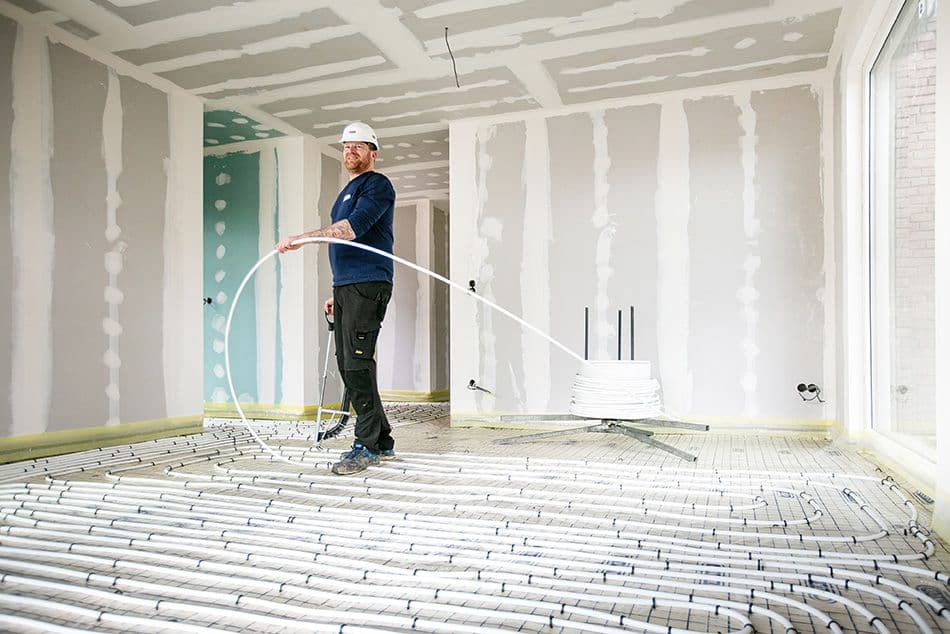
The underfloor heating pipes are fixed directly onto the insulation layer with tacker staples. This keeps the synthetic pipes firmly in place while the screed is poured, allowing the installer to work efficiently. Is tacking not possible? Then wire mesh or studded panels offer a reliable alternative for installing the underfloor heating.
Henco Floor tip
Working fast starts with working smart. Always follow the layout plan and avoid unnecessarily sharp bends. This reduces the risk of damage and prevents extra work afterwards.
2. Which underfloor heating systems are best suited to renovations?
Renovation projects often require a different approach than new builds. The available build-up height, the load-bearing capacity of the existing floor and the desired finish all help determine which solution is most suitable.
For projects where a limited build-up height and fast installation are crucial, the new Henco XPS panels are an interesting choice. These lightweight panels combine insulation and underfloor heating in a single system.
Thanks to the integrated pipe grooves, the multilayer pipes can be laid quickly and accurately, while the aluminium top layer ensures even heat distribution.
Because of their low weight, the panels are particularly well suited to existing homes, apartments and timber floor constructions.
3. Is balancing underfloor heating worth the investment?
With the rise of zone control, different rooms are increasingly controlled separately. As a result, some heating groups can close while others remain active.
In larger installations, pressure-independent valves can ensure that the flow rate in each circuit remains constant, regardless of pressure fluctuations in the system.
For buildings such as offices, schools, healthcare facilities and other commercial projects, this often offers clear added value.
For most homes, however, a correctly designed and statically balanced underfloor heating installation is sufficient. In such applications, the extra investment costs of dynamic valves do not always outweigh the limited added value.
4. Can you cool with underfloor heating?
Yes. In combination with a heat pump, underfloor heating can also be used for floor cooling.
The advantage? A more pleasant indoor climate on warm summer days, without draughts, noise or a separate air-conditioning installation.
To prevent condensation, a supply temperature of around 17°C is usually used. This keeps the floor above the dew point, so no moisture forms on the surface.
For an optimal result, the following are often chosen:
a pipe spacing of 10 cm;
floor finishes with good thermal conductivity, such as tiles;
correct control of temperature and humidity.
The result is pleasant, even cooling that works in complete silence.
5. How do you prevent damage to your underfloor heating system?
A correctly installed underfloor heating system has a very long service life. Any damage usually does not occur during use, but during later works in which pipes are accidentally drilled into.
That is why a few simple checks are essential:
Always carry out a pressure test before pouring the screed.
Take photos of the entire pipe layout.
Keep the layout plan safe.
Use only high-quality, certified materials.
Observe the prescribed installation instructions for the pipes.
Many professionals therefore choose multilayer pipes with an aluminium core. These combine dimensional stability, limited thermal expansion and high oxygen tightness for maximum long-term reliability.
Choose peace of mind with Henco underfloor heating
Whether it concerns new builds, renovations, floor cooling or a heat pump installation: with Henco underfloor heating you choose a complete underfloor heating solution that combines comfort, reliability and ease of installation.
Thanks to high-quality multilayer pipes, innovative systems and expert technical support, Henco helps installers complete every project faster, more efficiently and more sustainably.
Looking for the right underfloor heating solution for your project? Discover the full range from Henco Floor, including systems for new builds, renovations and floor cooling.
TL;DR
Tacker systems are still the most popular choice for underfloor heating thanks to their fast installation, reliability and favourable price.
For renovations, dry-build systems such as XPS panels are ideal thanks to their limited build-up height, low weight and suitability for timber floors.
Automatic balancing mainly benefits larger buildings with multiple zones. For most homes, a correctly balanced installation is sufficient.
Underfloor heating can also cool in combination with a heat pump, for a pleasant indoor climate without draughts or noise.
You prevent damage by carrying out a pressure test, documenting the pipe layout and using high-quality materials.
With the right systems and multilayer pipes, underfloor heating offers a comfortable, energy-efficient and sustainable solution for both new builds and renovations.